TransJustice Meeting Cancelled
When:
Saturday, August 13, 2011 - 2:00pm
TransJustice meeting on 8/13/11 cancelled. Please join us at Chillin and Grillin
TransJustice meeting on 8/13/11 cancelled. Please join us at Chillin and Grillin
ALP's 14th Annual FREE Community Outing & Bar-B-Q!
Unfortunately the 3rd Space Legal Clinic is cancelled for the month of August.
If you are low-income, transgender, intersex and/or gender non-conforming and need legal support; please go to SRLP's Drop In Legal Services.
Thursday, August 11, 2011 - 1:00pm - 5:00pm
SRLP Office: 147 W. 24th Street, 5th Floor
SRLP legal services drop-in hours are a place for people to come if they have legal questions, or want SRLP to represent them in legal issues.The main issues we work on are name changes, changing id cards and birth certificates, immigration issues, public benefits like welfare and SSI, and advocacy for prisoners.
You are invited to ALP’s Membership HAIR, NAILS, and Pupus Party! Come with your best hairdo, hair design, mustache, beard, facial hair, and nails design! And if you don’t have any hair or fancy nails come with your fabulous self and check out people’s designs, eat some delicious pupus with us, meet new folks, and learn about the Audre Lorde Project!
The offices of the Audre Lorde Project in Manhattan and in Brooklyn will be closed from June 25th till July 4th. We will be back in the office on Tuesday, July 5th.
|
CALLING ALL LGBTSTGNC PEOPLE OF COLOR & ALLIES...
SALGA NYC & the Audre Lorde Project Present: COLOR ME QUEER! |
It is that time of year again. Come join TransJustice of the Audre Lorde Project for our annual Trans Day of Action. We will take to the streets of New York City to raise awareness and to celebrate the accomplishments of the Trans and Gender Non Conforming community.
Time: Rally & March 3:00 pm, Closing Rally 6:00pm. Both at Foley Square
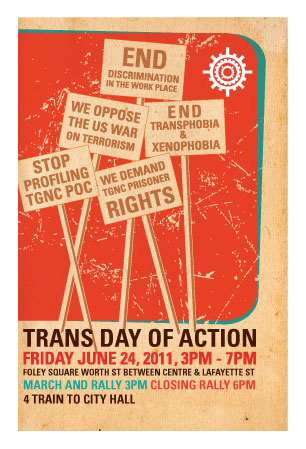
To endorse the Trans Day of Action 2011, send an email to endorsetdoa@alp.org and for more information about the march send an email to info4tdoa@alp.org or contact Mya Leilani Vazquez at 212-463-0342 x 15.
Contact:
to RSVP by monday, June 27
As Lesbian, Gay, Bisexual, Trans and Gender Non-Conforming people of color, we live at the intersections of multiple oppressions. From daily media messages to messages from our childhood, we sustain wounds that we carry with us, often going without healing. We do what we need to do to survive, and when we lack access to care and sustenance, we find our own ways to self-medicate.
Many in our community have found the space for healing through harm reduction or 12 step models. Harm reduction counseling and 12 step organizations are welcome tools in our quest for healing—though those tools speak only to a segment of our community and are neither ubiquitous nor effective enough to stem the ever growing tide of HIV infections and substance abuse. The annual numbers released by the CDC speak to this so very clearly.
For many queer people of color those spaces and rooms continue to lack a cultural component that is essential to understanding our healing and well being. When we walk into places of healing but do not see ourselves or our stories reflected in those places, many of us are unable or unwillingly to set our skins aside in order to access a generic cure-all. Indeed, sometimes those places, where racism is sometimes unexamined and methods of communication and engagement are unreflective of the ways in which our communities communicate, our people often times find more harm than help. Yet, when those are the central tools for healing, what about everyone else? Where are the answers they need? Where is the healing we need?
Come march with the Audre Lorde Project's Safe OUTside the System Collective this Saturday at Brooklyn PRIDE!
Come march with TransJustice and Audre Lorde Project's Safe OUTside the System Collective this Saturday at Brooklyn PRIDE!